In this story
A note from Common Ground
Project editorial introduction based on a bounded official summary; observation prompts are editorial.
Between two positions
UNESCO's introduction describes taijiquan through relaxed, circular movement and identifies several schools or styles. That makes a transition between positions a useful subject for cultural observation. A still pose may catch your eye, but your question can concern how movement continues rather than how to reproduce a shape. [S1]
Imagine an invented scene in a US park: you encounter a publicly announced demonstration and choose to watch from an appropriate distance. This is not a report of an actual event. Your purpose is to notice a learned practice, not assess anyone's health or begin an unsupervised routine.
Media selection · Reviewed by the project owner on November 5, 2026. Context images do not replace the story’s cited evidence.
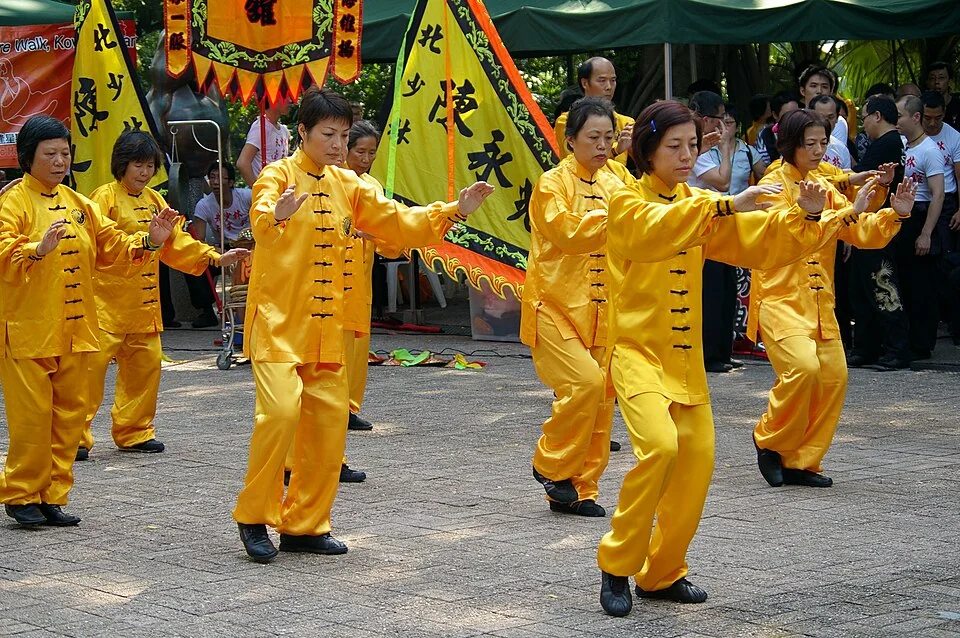
One group performance: a view of people moving together, rather than an exercise prescription.
Image source & license
Jakub Hałun · CC BY-SA 4.0. WebP delivery copy; resized if needed, composition unchanged. Original image & full credit · License
Learning has relationships
The official account describes steps, movement techniques, and partnered hand-pushing skills called tuishou. It also describes how people learn: within families, through teacher-apprentice relationships, and in formal education. Schools may be named for clans or individual masters. Learning here involves relationships as well as movements. [S1]
Those details move the conversation beyond a lone silhouette. You can ask which learning community a demonstration represents and how the participants describe their own tradition. Do not infer a lineage from a person's clothing, age, apparent background, or the location where you happen to see them.
Watch without prescribing
A letter dated November 20, 2018 makes the learning relationships concrete. In the UNESCO nomination materials, Chenjiagou’s Villagers Committee described bringing taijiquan into the village elementary school, supporting teachers and their institutions, and joining six other communities in a safeguarding committee in 2017. This is the community’s own account of its work, not proof that every child participated. A movement tradition needed schoolrooms, teachers, meetings, and decisions as well as people practicing it. [S2]
Keep cultural questions distinct from claims about effectiveness. Watching a demonstration cannot establish medical outcomes or tell you what activity suits another person. Likewise, an unfamiliar movement is not a reliable guide to a practitioner's beliefs. Ask for context when discussion is invited rather than treating appearance as a complete explanation.
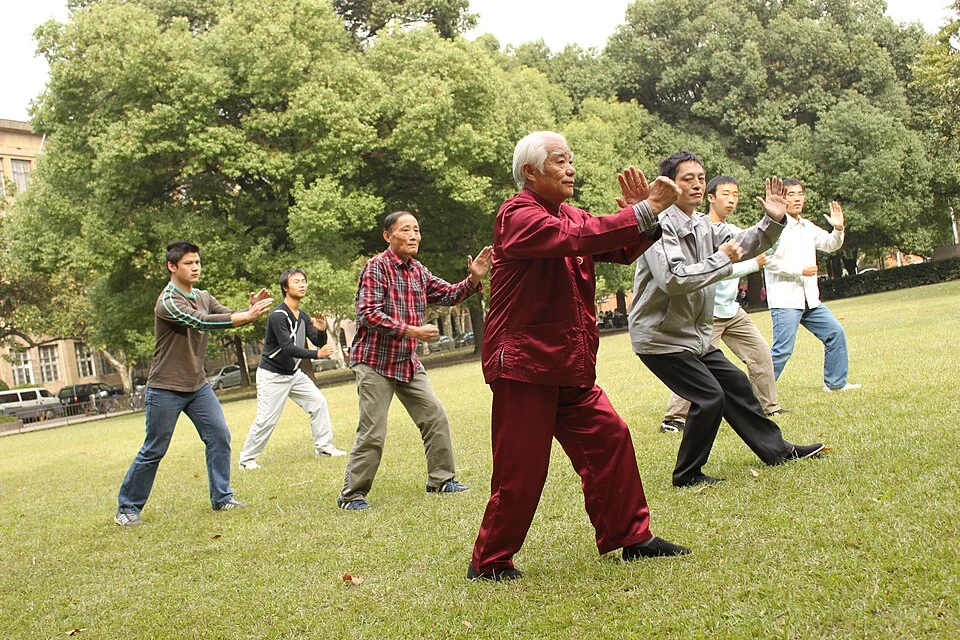
A practice group outdoors. Learning takes place in different settings and relationships.
Image source & license
Seattletaijiquan · CC BY-SA 4.0. WebP delivery copy; resized if needed, composition unchanged. Original image & full credit · License
A question worth keeping
Your field note can be brief: “I noticed a continuous change of direction. UNESCO describes multiple schools and learning relationships. How does this group explain the sequence?” That combines a personal observation, a bounded source detail, and a question someone could actually answer. It leaves room for a different account from another community.
If you share the note, preserve that scope. Do not turn it into a how-to guide or a promise of results. The worthwhile discovery is that a movement has teachers, learners, terminology, and contexts beyond its outline. Looking carefully can be an introduction to those relationships while allowing the people involved to explain what their practice means.
3 optional questionsWant a tiny challenge?
A little practice, with room to try again.
Want a tiny challenge?
A little practice, with room to try again.
How did this land?
Just your reaction, kept in this browser. Tap again to change your mind.
A little trail to follow.
Want to dig into a detail? These links take you to the original sources. Our suggestions and imagined examples are labeled in the story.
- UNESCO — Taijiquan (opens in a new tab)
Official heritage summary; read through search-index text. Direct page access was not established. Limited introductory scope; not an independent field study.
- UNESCO nomination: Chenjiagou Villagers Committee consent letter (opens in a new tab)
Letter dated November 20, 2018: elementary-school introduction, teacher/institution support and a 2017 seven-community safeguarding committee. Substantive indexed letter text; direct access required human verification. No health or universal-participation claim.
What did you notice, and what still needs context?
Your question, a memory, a different way your family does things — there's room for it here. These notes are just for you in this browser.
Downloads and copies include notes and corrections for this story. To send it to us, attach it yourself in an email to support@goodbye.help. Saved stories and practice scores stay out of the download.