In this story
A note from Common Ground
Project editorial: sourced details are separated from imagined practice scenes.
A square waiting to change
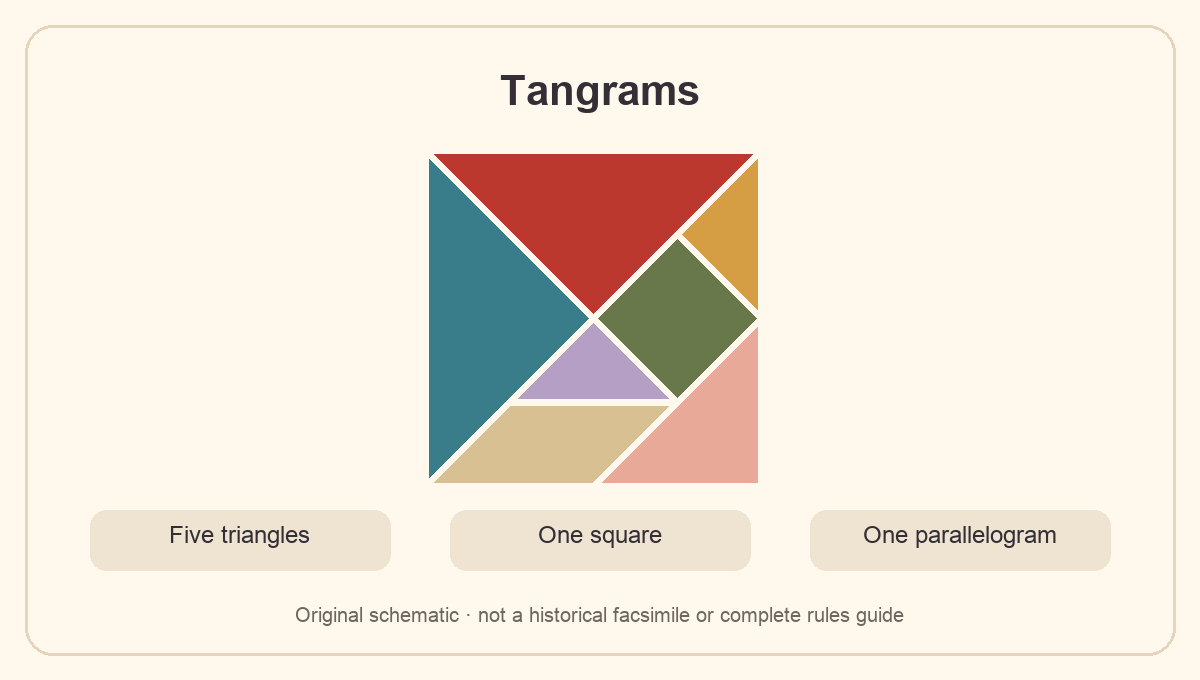
Seven loose pieces can look like the beginning of a picture you have not recognized yet. The University of Oregon’s Jordan Schnitzer Museum of Art describes a tangram set as five triangles, one square, and one parallelogram. Its Chinese Art and Culture Outreach Kit places this small puzzle inside a lesson about experimenting with shapes. [S1]
Before hunting for a solution, count what is on the table. The same inventory can become the basis for very different outlines. That is the appealing tension: the materials stay limited while your interpretation keeps changing. You do not need a large collection of pieces to make another attempt.
Media selection · Reviewed by the project owner on November 5, 2026. Context images do not replace the story’s cited evidence.
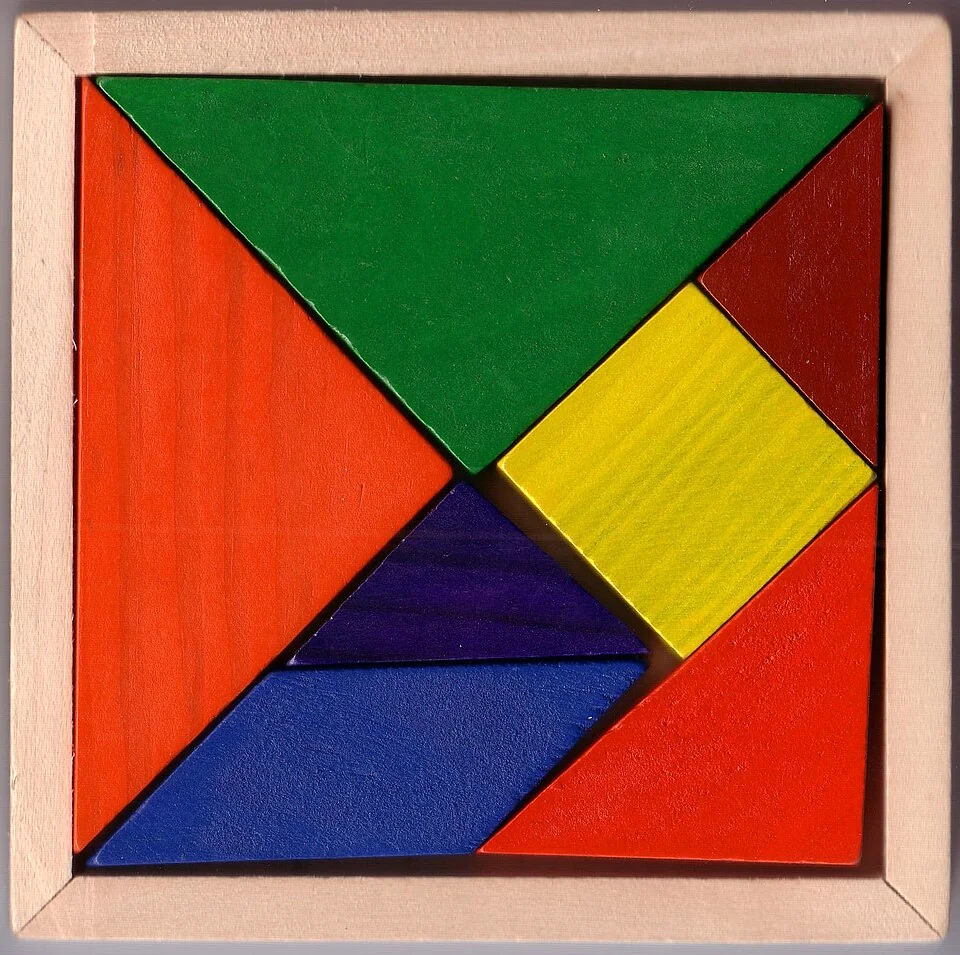
A physical tangram set with its pieces together.
Image source & license
Nevit Dilmen · CC BY-SA 3.0. WebP delivery copy; resized if needed, composition unchanged. Original image & full credit · License
A history with an open space
The museum’s guide locates the puzzle’s origin in China but says its invention date and the origin of the English name are uncertain. It describes tangrams reaching Europe and America in the early nineteenth century, alongside renewed interest in China. That is a modest historical journey, without an identified inventor attached. [S1]
The museum leaves the invention date open. We can enjoy experimenting with the puzzle without filling that gap with an invented origin story. Seven pieces are something we can count; an inventor is someone this source does not identify.
Let a friend see something else
Imagine an invented afternoon at a public-library craft table in the United States. You arrange your pieces into an angular creature; a friend sees a person leaning into the wind. Ask which edge suggested that reading. Their answer can send you back to a shape you thought you already understood.
For this activity, agree to use all seven pieces without overlapping them. Make a silhouette, then ask your partner to rebuild it. This is a suggested challenge for your table, not a claim that the museum’s historical paragraph specifies every rule. Keep the original arrangement nearby so you can compare attempts.
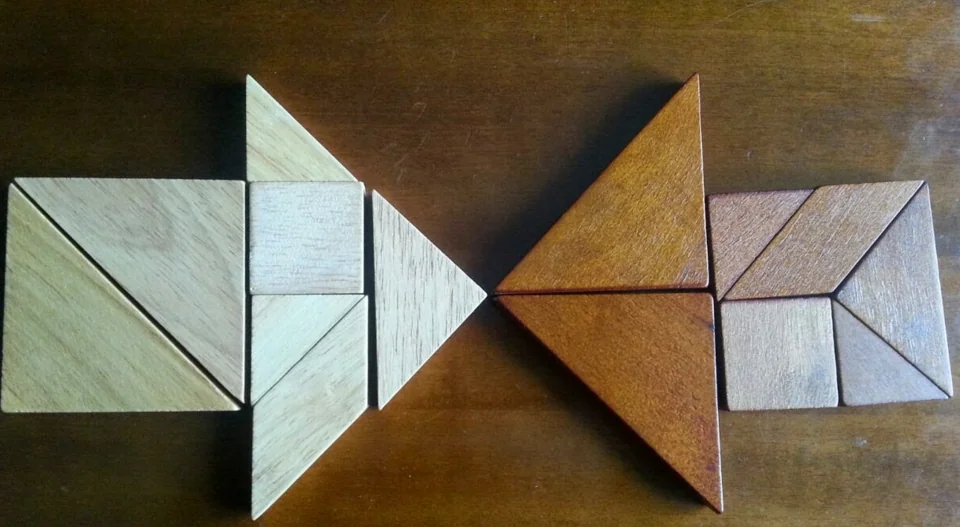
Other tangram arrangements invite a second try. Follow the edges and count the pieces.
Image source & license
Gorkaazk · CC0. WebP delivery copy; resized if needed, composition unchanged. Original image & full credit · License
A puzzle without a stopwatch
The museum lesson invites students to experiment, discuss difficulty, and invent puzzles of their own. You can borrow that sequence without turning the afternoon into a speed test. First try, then describe what changed, then offer someone else a new shape to investigate. A puzzling attempt can still produce a useful observation. [S1]
In your notes, distinguish the set’s documented contents from the picture you imagined. Write down one rotation that changed your reading and one historical question still unanswered. Seven pieces give you something concrete to handle; the gaps in the history give you a reason to remain curious.
3 optional questionsWant a tiny challenge?
A little practice, with room to try again.
Want a tiny challenge?
A little practice, with room to try again.
How did this land?
Just your reaction, kept in this browser. Tap again to change your mind.
A little trail to follow.
Want to dig into a detail? These links take you to the original sources. Our suggestions and imagined examples are labeled in the story.
- University of Oregon: Chinese Art and Culture Outreach Kit (opens in a new tab)
PDF printed pages 47–48: piece inventory, uncertain invention and English-name origins, nineteenth-century circulation, experimental lesson.
What did you notice, what supports it, and what remains open?
Your question, a memory, a different way your family does things — there's room for it here. These notes are just for you in this browser.
Downloads and copies include notes and corrections for this story. To send it to us, attach it yourself in an email to support@goodbye.help. Saved stories and practice scores stay out of the download.