In this story
A note from Common Ground
Project editorial: sourced details are separated from imagined practice scenes.
Begin with one painting
Wu Li’s Travelers among Streams and Mountains offers a surprising place to begin looking at Chinese landscape painting: its composition drew on an earlier painting. The Metropolitan Museum of Art dates this ink-on-paper hanging scroll to probably the 1670s. Its account follows a composition through an album of reduced copies and into Wu’s own work. [S1] [D1]
That chain gives a viewer a question more interesting than whether the landscape resembles a photograph. What might an artist notice in an earlier arrangement, and what could happen while making it again? Keep that question beside the title. It offers a way into one work without making it represent every landscape.
Media selection · Reviewed by the project owner on November 5, 2026. Context images do not replace the story’s cited evidence.
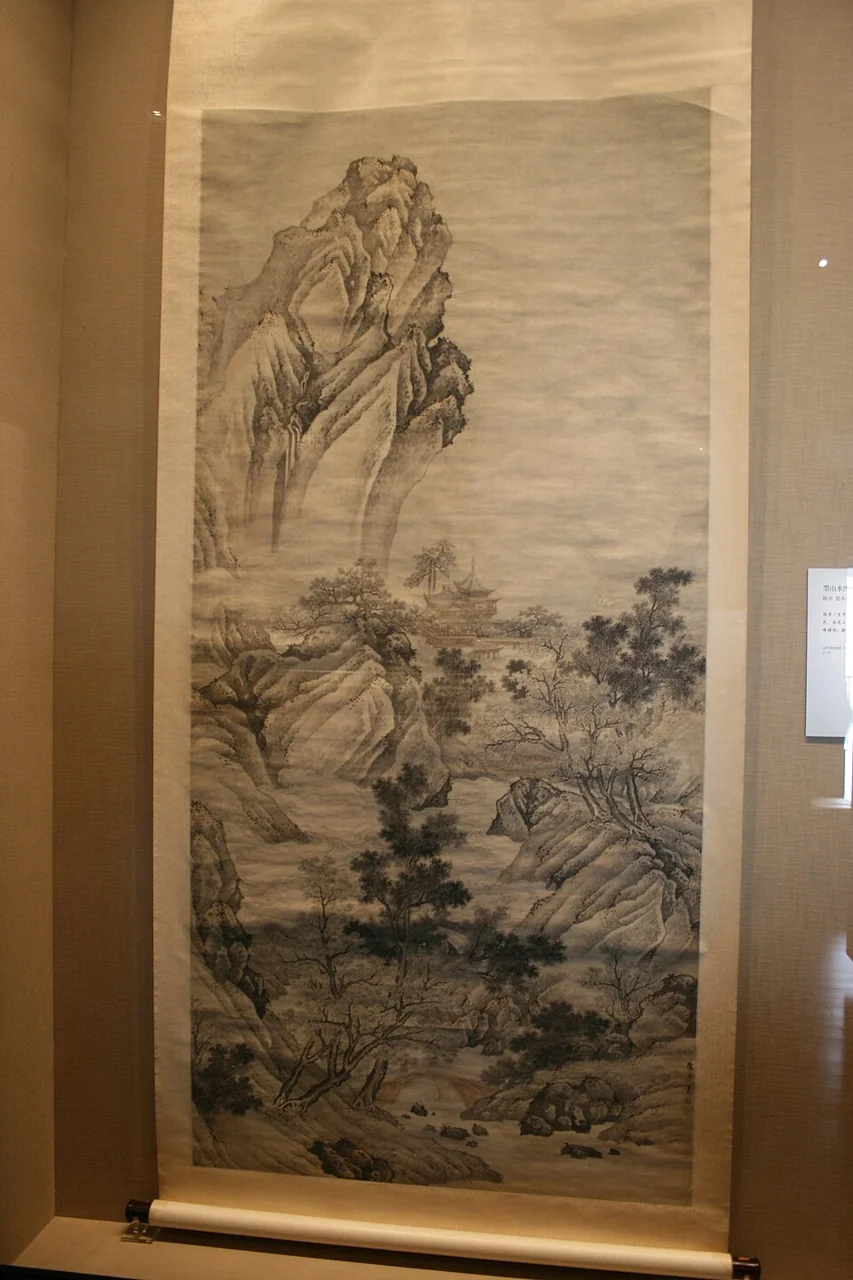
A collection image of a landscape painting, separate from Wu Li’s named scroll.
Image source & license
Gary Todd · CC0. WebP delivery copy; resized if needed, composition unchanged. Original image & full credit · License
An album between artists
According to the Met, Wu studied an album owned by Wang Shimin. It contained smaller copies of Song and Yuan masterpieces. For this scroll, Wu followed an album page preserving a composition by Wang Meng. The museum describes how his brushwork brought renewed life to that earlier composition. [S1]
The word copy can make a modern reader expect a mechanically identical result. Here, the distinction is between working from an earlier composition and making it your own with brush and ink. The museum’s story asks us to notice what carried over and what changed.
Give gray a second look
The Met emphasizes Wu’s handling of different gray tones to create atmosphere and the responsiveness of his brushwork as the painting develops. That is a specific curatorial interpretation of this work. It gives us a looking prompt: attend to differences within ink, rather than treating the material as a single flat black. [S1]
When you open the museum’s reproduction yourself, try two passes. First notice broad relationships of light and dark. Then choose a smaller area and describe what you actually see. This is a proposed viewing exercise, not a report that the image has been inspected for this article. You may notice something the text does not mention.
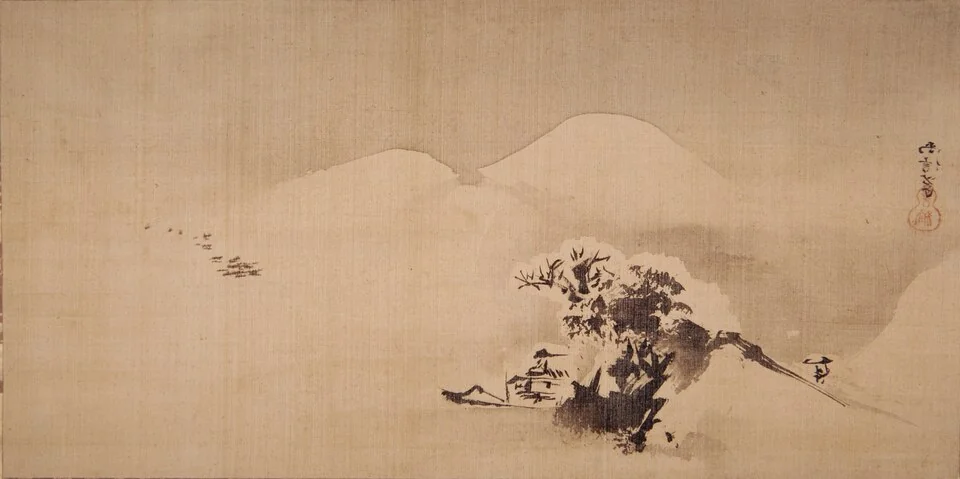
Comparison image: a winter landscape by Japanese painter Kanō Naonobu. This is not Wu Li’s Chinese scroll.
Image source & license
Kanō Naonobu · Public domain. WebP delivery copy; resized if needed, composition unchanged. Original image & full credit
Borrow a question, not a verdict
Imagine an invented visit with a friend to an art website from your kitchen table in the United States. You disagree about where your eyes pause. Instead of deciding whose response is correct, compare the visible details behind each response. The conversation becomes more useful when an impression has something concrete attached to it.
Write one sourced fact about the album connection, one observation from your own viewing, and one question for another visit. Keep the museum’s cautious dating intact. A painting with a history of looking backward can still invite a fresh encounter, especially when you allow yourself time to look twice.
Use the comparison images to notice differences in ink and composition. They are not all the same object, place, or painting tradition.
3 optional questionsWant a tiny challenge?
A little practice, with room to try again.
Want a tiny challenge?
A little practice, with room to try again.
How did this land?
Just your reaction, kept in this browser. Tap again to change your mind.
A little trail to follow.
Want to dig into a detail? These links take you to the original sources. Our suggestions and imagined examples are labeled in the story.
- The Met: Wu Li, Travelers among Streams and Mountains (opens in a new tab)
Object 1981.285.6: probably 1670s, hanging scroll in ink on paper; Wang Shimin album, Wang Meng composition, gray tones and responsive execution.
- The Met public API — object 41485 (opens in a new tab)
Actual JSON HTTP200 November 2, 2026 confirms Wu Li, title, probably 1670s, hanging scroll and ink on paper. API metadata does not corroborate the full curatorial narrative.
What did you notice, what supports it, and what remains open?
Your question, a memory, a different way your family does things — there's room for it here. These notes are just for you in this browser.
Downloads and copies include notes and corrections for this story. To send it to us, attach it yourself in an email to support@goodbye.help. Saved stories and practice scores stay out of the download.