In this story
A note from Common Ground
Project editorial introduction based on a bounded official summary; observation prompts are editorial.
Follow one joint
A movable joint is a useful place to begin a story about shadow puppetry. UNESCO describes Chinese shadow puppets made from leather or paper, worked with rods against a translucent, backlit screen. Music and singing accompany the figures. The object and the performance belong in the same picture. [S1]
Imagine watching an announced demonstration at a US community event. This scene is invented, not a venue recommendation. You notice a figure turn and want to know how the movement happened. Instead of treating the silhouette as a self-contained image, let that question lead you behind it.
Media selection · Reviewed by the project owner on November 5, 2026. Context images do not replace the story’s cited evidence.
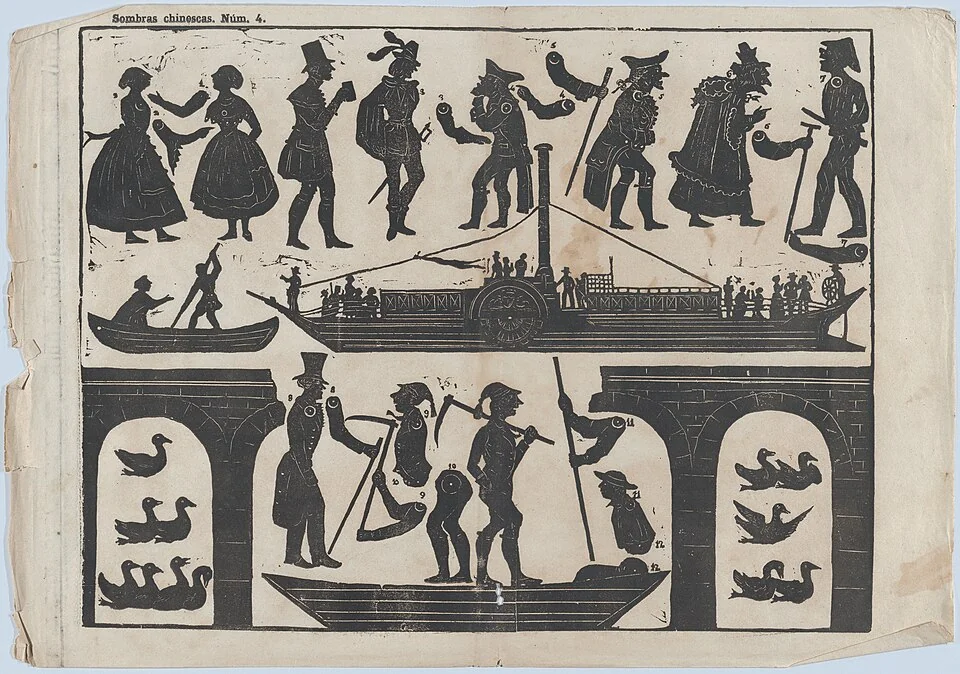
A collection sheet of shadow-play figures. Look at the silhouettes before imagining their movement.
Image source & license
Creator:Juan Llorens · CC0. WebP delivery copy; resized if needed, composition unchanged. Original image & full credit · License
The people behind the image
The official summary describes performers who may manipulate several figures, sing, play instruments, and carve puppets. It gives examples of figures with twelve to twenty-four movable joints. Skills pass within families and troupes and between teachers and pupils. These are descriptions of a varied tradition, not requirements for every troupe. [S1]
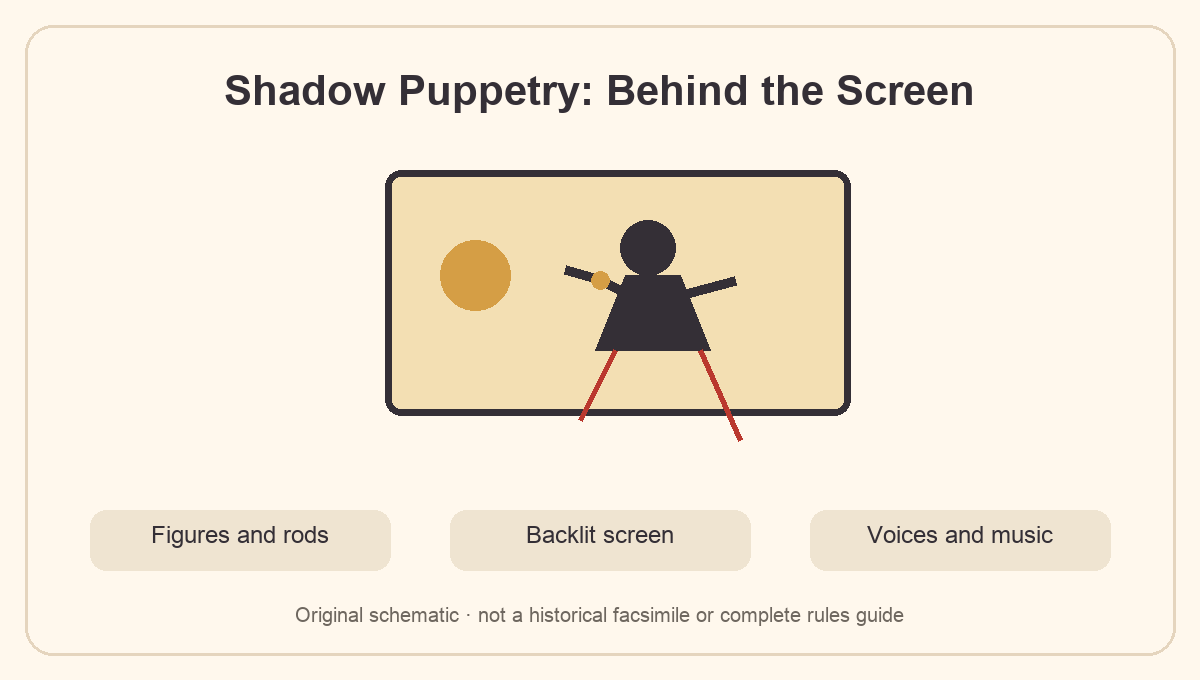
China’s National Library gives this tradition names as well as a category: its heritage record lists a Taishan shadow-puppetry showcase credited to Fan Zheng’an. We read the credit, not the recording. Think of the jointed arm in our simple diagram: separate pieces can bend where a flat outline cannot. That small mechanism gives you a question to bring to this particular artist’s work, without inventing what happens in a performance we have not watched. [S2]
Two kinds of attention
For a future viewing, try giving separate attention to an image and its timing. Describe one visible change, then ask how the accompanying sound relates to it. This is an observation prompt, not a report that we watched the source's video or a claim that every scene follows one pattern.
If you cannot see the operators, resist inventing their exact actions. “The figure's arm changed position” is safer than asserting which hand moved which rod. A program, explanation, or conversation with a demonstrator could later help you connect an effect with its making.
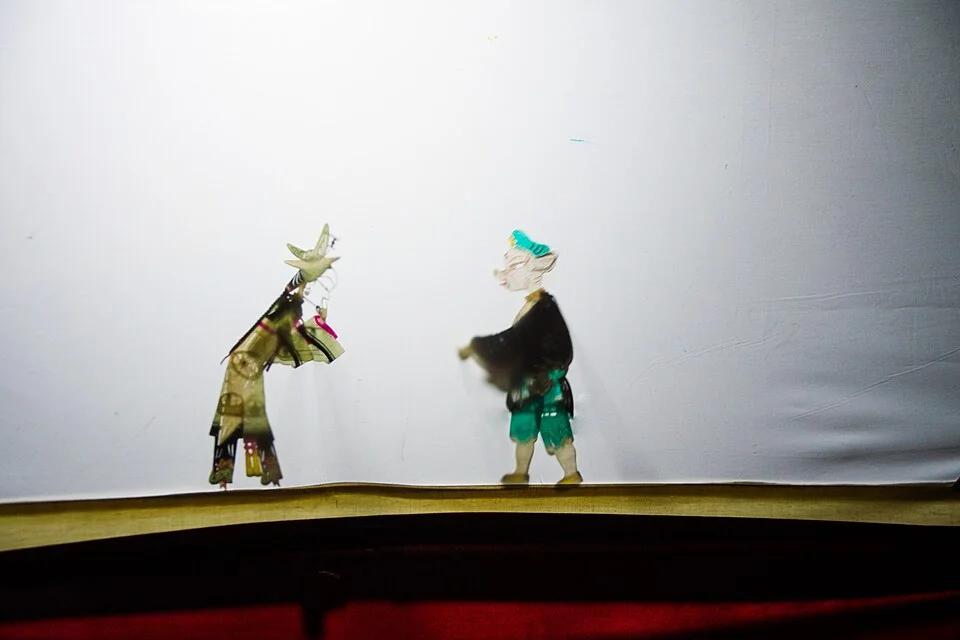
A shadow-puppetry scene photographed in Xi’an, separate from the named performer’s account in the text.
Image source & license
Mitch Altman from San Francisco, USA · CC BY-SA 2.0. WebP delivery copy; resized if needed, composition unchanged. Original image & full credit · License
Keep the team in view
A useful field note can preserve both curiosity and credit. Write one thing you noticed, one detail supported by the UNESCO introduction, and one question about the work behind the screen. For example: “Who made the figure, and who performs its voice?” The answer might involve different people.
When sharing an introduction, avoid reducing the form to an early version of a digital screen. That comparison may be your personal doorway, but it leaves the people out. Give your reader room to imagine a performance assembled through skilled hands, voices, materials, and learning relationships, rather than only an attractive shadow.
3 optional questionsWant a tiny challenge?
A little practice, with room to try again.
Want a tiny challenge?
A little practice, with room to try again.
How did this land?
Just your reaction, kept in this browser. Tap again to change your mind.
A little trail to follow.
Want to dig into a detail? These links take you to the original sources. Our suggestions and imagined examples are labeled in the story.
- UNESCO — Chinese shadow puppetry (opens in a new tab)
Official heritage summary; read through search-index text. Direct page access was not established. Limited introductory scope; not an independent field study.
- National Library of China: Chinese shadow puppetry heritage record (opens in a new tab)
Chinese text lists a Taishan shadow-puppetry showcase credited to Fan Zheng’an. Text/credits read; recording not watched. Our joint diagram is a model, not a transcription of his technique.
What did you notice, and what still needs context?
Your question, a memory, a different way your family does things — there's room for it here. These notes are just for you in this browser.
Downloads and copies include notes and corrections for this story. To send it to us, attach it yourself in an email to support@goodbye.help. Saved stories and practice scores stay out of the download.